Article
Buying a farm or agricultural land in France: what to check first
A stone house with a barn, a meadow and quiet all around. Anyone considering buying a farmhouse in France, or looking for land for sale in the Dordogne, Lot or Corrèze, quickly sees the appeal: space, fruit trees, perhaps your own grazing animals or a patch of woodland.
Yet such a purchase is different from buying an ordinary house. With a farm for sale France listing or a standalone plot, it matters who is entitled to work the land, whether a tenant farmer is in place, what the barns are zoned for, and whether you are actually allowed to build. None of this appears in a listing. Yet it determines whether the purchase is feasible — and what it really costs.
This article sets out the checks you can make before making an offer, together with the official French rules and deadlines.
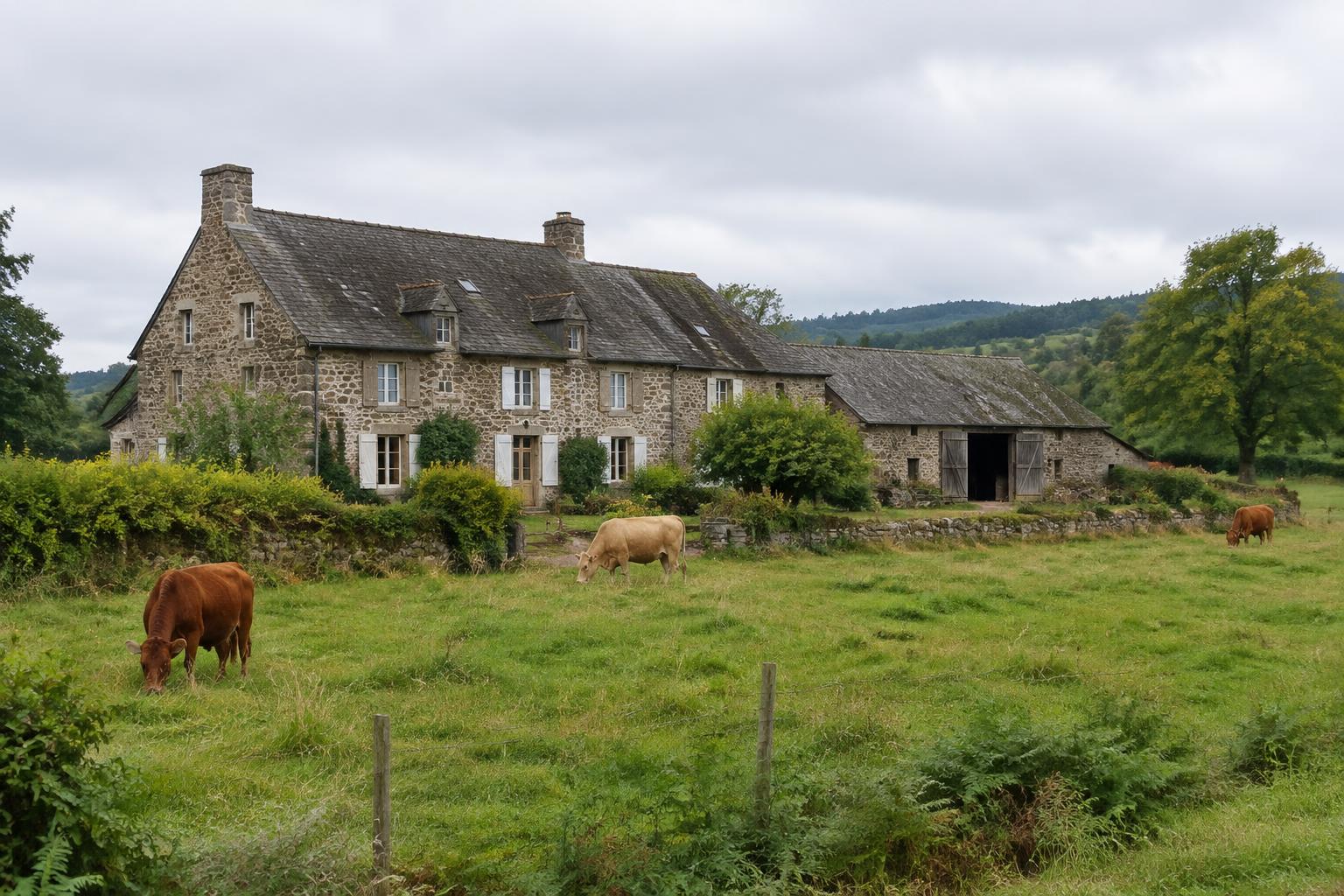
Already have a farm or plot in mind? Email us the link and, in one sentence, what you plan to do with the land. We'll check whether your plans fit what is officially allowed.
Email us about this farm1. Start with the question: what do you want from the land?
Before any checks, it helps to clarify what you intend to do: live there with a garden, keep a horse or two, manage woodland, rent it out, or farm it yourself. That sounds simple, but it determines which rules will apply to your purchase.
If you simply want to live there, you will mainly deal with the local zoning plan (PLU), permits and upkeep. If you want to convert buildings, lease out land or farm it yourself, you will also run into the farm lease statute, controls on agricultural structures, and sometimes a permit to convert woodland into open land.
- What should the land deliver? Nothing, just atmosphere and timber, grazing for your own animals, or income.
- What should happen in the barns? Storage for personal use, a guest cottage, a workshop, or rental.
- Which plans could affect the zoning? A barn turned into a dwelling, or a meadow turned into open land, are examples that may require permission.
In agricultural zones, not everything is allowed, and a plan that doesn't fit the zoning isn't a point for negotiation — it's an obstacle you must resolve or accept before making an offer.
2. SAFER is notified when a rural property is sold
In France, the notary must notify SAFER — the land agency that oversees the distribution of agricultural land on behalf of the state — of any planned sale of a rural property. This notification must be made at least two months before the final deed is signed.
SAFER can then exercise its pre-emption right: it may take over the property at the asking price, or propose a revised price to the seller. This happens far from always. In 2023, SAFER bodies received 393,800 notifications from notaries; in 3,750 cases (about 1%), the pre-emption right was actually exercised.
- It's a standard procedure, not chance. The notary arranges the notification for every sale of a rural property; still ask for confirmation in the file and what came of it.
- Sales within the family are often excluded. Sales between co-heirs, relatives up to a certain degree, or co-owners are generally exempt.
- Woodland is treated separately in principle. Plots registered in the land registry as forest generally fall outside SAFER's pre-emption right, because forestry isn't classed as farming. For small wooded plots (usually under four hectares), a different pre-emption right may apply, held by the municipality or the owner of an adjoining wooded plot — that is not a SAFER right.
- A house with some land is not automatically "rural". Whether a property falls under the pre-emption right depends on its actual use and location. Have the notary confirm this in writing for your specific file.
Buying through a company? Since 1 January 2023, an additional notification duty applies: a change of control in a company that owns or farms agricultural land must also be notified to SAFER in advance. Ask the notary to assess whether this applies to your situation.
3. If a tenant farmer is on the land, they stay
Buying a farm with leased land or buildings generally means buying into an existing lease as well. Leases on agricultural land and buildings fall under the statut du fermage: a protective legal framework that cannot be contracted out of. On a sale, the lease generally continues; the new owner takes the seller's place.
- The rent is regulated. It must lie between a minimum and maximum set by the prefect, and is indexed annually.
- The tenant generally has a right to renewal. The lease renews automatically by default, subject to limited statutory exceptions.
- The tenant has their own pre-emption right under certain conditions. The rural code gives a sitting tenant a statutory pre-emption right when the leased property is sold, provided they meet the conditions.
So before making an offer, ask for a copy of the lease with a list of plots, its term and rent, an overview of all leased plots, and whether the tenant intends to exercise their pre-emption right — if not, have that confirmed in writing. If there is no written lease, or only verbal arrangements, treat that as an open question, not as a formality that will sort itself out later.
4. Zoning and permits: what a barn can actually become
A barn or stable isn't automatically an extra dwelling. Two questions determine what you may do with it: what does the local zoning plan (PLU) say, and does the building's official use need to change?
Agricultural or natural zone (A/N) in the PLU. Agricultural and natural zones in the zoning plan are generally not open to construction. Only strictly defined projects can be approved there, such as housing needed for the farm operator's presence, farm buildings, or certain forms of on-farm accommodation. In municipalities without a PLU, stricter national rules apply. In all cases, planning approval is required — a prior declaration, a building permit, or a development permit — applied for at the town hall (mairie).
Change of use of a barn. If you want to turn a farm building into a dwelling, rent it out, or use it as a workshop, that is often a change of use (changement de destination). The application is filed with the mairie: a prior declaration if the façade and load-bearing structure stay unchanged, otherwise a building permit.
Farming the land yourself: controls on agricultural structures. Anyone who will farm or lease agricultural land may need an operating permit (autorisation d'exploiter) under the controls on agricultural structures. The application goes through the DDT (Direction départementale des territoires) of the department, which also assesses whether you meet the conditions.
Converting woodland into open land. If you want to remove trees to clear land, a prior permit is generally required (défrichement). This application also goes through the DDT.
- Which PLU zone are the plots and buildings located in?
- What approval would be needed for my specific plan for the barn?
- Have any permits been granted or refused for this address in the past?
Have the answers confirmed in writing. A verbal explanation given on the spot at the mairie is not an approval.
Unsure about the lease, land use or zoning? Email us the link and, in one sentence, what you plan to do. We'll tell you which documents to request and what the implications are for your plans.
Email us about leases and land use
5. Boundaries, access and water: what the land registry doesn't show
The cadastral map shows the plots, but is not proof of the exact boundaries. For land and estates, a boundary survey (bornage) by a licensed surveyor (géomètre-expert) is advisable, and sometimes required before a subdivision or new construction. A difference of a few metres can be worth a great deal, especially where several plots surround the same farm.
Also ask about easements: rights of way, view or pipelines that burden the land or benefit it. Is the access road owned as part of the plot, shared with neighbours, or a right of way? Have the notary confirm this from the deed and the land registry.
Water requires a separate check. Not every remote building is connected to the public drinking water network; sometimes a private well or spring is used, with its own maintenance obligation and sometimes a declaration or permit requirement from the municipality. If you use water for irrigation or livestock from a stream or spring, check whether a permit is required for that, and whether one already exists for the plot.
6. Woodland: management plan and permits
If woodland is part of the farm, ask whether a management document exists, such as a plan simple de gestion (PSG), and whether any recent logging has taken place. If you want to have woodland felled or converted yourself, the défrichement permit rules above apply. Management obligations and any support schemes depend on area and location; have this checked plot by plot with the relevant forest owners' organisation or the DDT.
7. What the purchase really costs
For an existing property, French notaries generally estimate 7 to 8% in acquisition costs. That's a guideline, not a fixed rate. Most of it is tax, and that depends on the department.
Transfer tax in the Dordogne, Lot and Corrèze. Since 1 April 2025, departments may temporarily raise the departmental rate from 4.50% to 5.00%. The official tax authority rate table dated 1 June 2026 lists a departmental rate of 5.00% for the Dordogne, Lot and Corrèze. Anyone buying a home for the first time that will become their main residence, and who meets the statutory conditions for such a first purchase, may qualify for the reduced rate of 4.50%. Whether you meet those conditions is assessed by the notary.
Worked example, not a quote: with the departmental rate of 5.00%, the total transfer tax percentage comes to roughly 6.3% of the purchase price; with the reduced rate of 4.50%, roughly 5.8%. On a purchase price of €400,000, that is roughly €25,200 versus €23,200. Adding the notary's fee, registration charges and ancillary formalities, the total lands around the 7 to 8% mentioned — for €400,000, roughly €28,000 to €32,000. Financing, any agency fees, purchase assistance, moving costs and renovation work are not included. The notary determines the actual amount for your purchase.
Separate schemes exist for agricultural land. For purchases by sitting tenants, young farmers, or in certain other cases, reduced registration tax rates exist. Whether one applies to your purchase is assessed by the notary; ask about it actively, as it is not always visible in a quote.
- The latest taxe foncière assessment, for both built and unbuilt property. The tax is charged to whoever owns the property on 1 January; a pro-rata split for the year is a matter of agreement between seller and buyer, not an automatic rule.
- A current cost estimate from the notary for this specific property.
- Written quotes for any necessary work, with clarity on VAT.
8. Systems, energy and drainage: what is and isn't tested
With a farm, the house and the outbuildings are not covered by the same file.
Energy performance (DPE). A DPE is mandatory when selling a home. Buildings not used for habitation, such as a purely agricultural barn, may be exempt where almost no energy is used for heating, cooling or hot water for human use. That exemption does not apply to the residential part. If an outbuilding is said to be exempt, ask for the reasoning, not just the absence of a DPE.
The full diagnostic file (DDT). Selling a house involves a file of surveys: electrics and gas for older installations, lead for buildings from before 1949, asbestos where the building permit predates 1 July 1997, termites in designated zones, the energy label, the condition of any non-collective drainage system, and risk information where applicable.
Drainage (SPANC). If the property is not connected to the public sewer, the seller must provide the notary with a SPANC report less than three years old. In the event of non-compliance, the buyer must bring the system up to standard within one year of the sale.
Energy audit. For the sale of a single-family house (maison individuelle) or a building under single ownership rated E, F or G, a mandatory energy audit has applied since 1 January 2025, in addition to the mandatory DPE; for ratings F and G, this has applied since 2023 already. The audit must be made available at the first viewing. Flats within mixed ownership do not automatically fall under this requirement — have special ownership situations, such as a farm with several separate dwelling units, assessed case by case.
Insurance and liability. For a house outside a homeowners' association, fire insurance is not legally required, but you remain liable to third parties for damage originating from your property. For a farm with many buildings, visitors or rentals, ask about appropriate cover.
Checklist: what to know before making an offer on a farm or plot
Note down, for each point, the answer, the supporting document, and what's still outstanding.
- Plan: what do I want to do with the land and the barns, and have I written it down?
- Lease: is there a lease agreement, and what does it say about term, rent and renewal?
- Tenant pre-emption: is it clearly confirmed in writing that the tenant will not use their pre-emption right?
- SAFER: has the notary made the notification, and what is the outcome or the applicable exception?
- Company: am I buying as an individual or through a company, and has the additional notification been made?
- Zoning: which PLU zone is the property in, and what answer has the mairie given to my plan?
- Agricultural structures: is an operating permit needed if I farm or lease the land myself?
- Land: are the plots, boundaries, access and easements clear; is a boundary survey needed or already done?
- Water: is there a connection to the drinking water network, a private well, and are there rights or permits for use?
- Woodland: is there woodland, and if so, is it covered by a management document (PSG) and are any conversions needed?
- Surveys: do I have the full diagnostic file for the house, and what has or hasn't been checked for the outbuildings?
- Drainage: is the SPANC report less than three years old, and does it state what work is needed?
- Costs: do I have a current notary estimate, and have any reduced agricultural schemes been assessed?
- Insurance: do I have a quote for appropriate cover for these buildings and this use?
Shall we discuss your plans? Email Ruud and Natascha your property link or search criteria, and your main questions. Even if you haven't chosen a property yet, you're welcome to get in touch; Bureau Moulin requests the documents from the agent, reviews the lease, zoning and plots with you, and carries out the viewings itself, within the Dordogne, Lot and Corrèze, up to one and a half hours' drive from Brive.
Email Ruud and NataschaSources
- Notaires de France — SAFER's pre-emption right on the sale of agricultural-use property
- SAFER — explanation of the pre-emption right and 2023 figures
- Légifrance — legal framework of the pre-emption right (Code rural, articles L.143-1 et seq.)
- CNPF Nouvelle-Aquitaine — pre-emption rights on wooded plots under four hectares
- Ministry of Agriculture — notification requirement for changes of control in agricultural land companies
- Service Public Entreprendre — the farm lease statute (statut du fermage)
- Service Public Entreprendre — rights and obligations of tenant and landlord
- Service Public Entreprendre — formation of the lease and controls on agricultural structures
- Mes démarches agriculture — operating permit (controls on agricultural structures)
- Service Public — building in an agricultural zone of the local zoning plan
- Service Public — change of use of a building
- Notaires de France — notary fees when buying an existing property
- Service Public — temporary increase in transfer tax by department
- Tax authority (DGFiP) — official transfer tax rate table by department, 1 June 2026
- Service Public — mandatory technical surveys when selling a home
- Service Public — mandatory energy audit when selling an energy-intensive home
- Service Public — SPANC report and remediation deadline
- Service Public — owner's insurance and liability