Article
A chateau for sale in France: protection, costs and upkeep
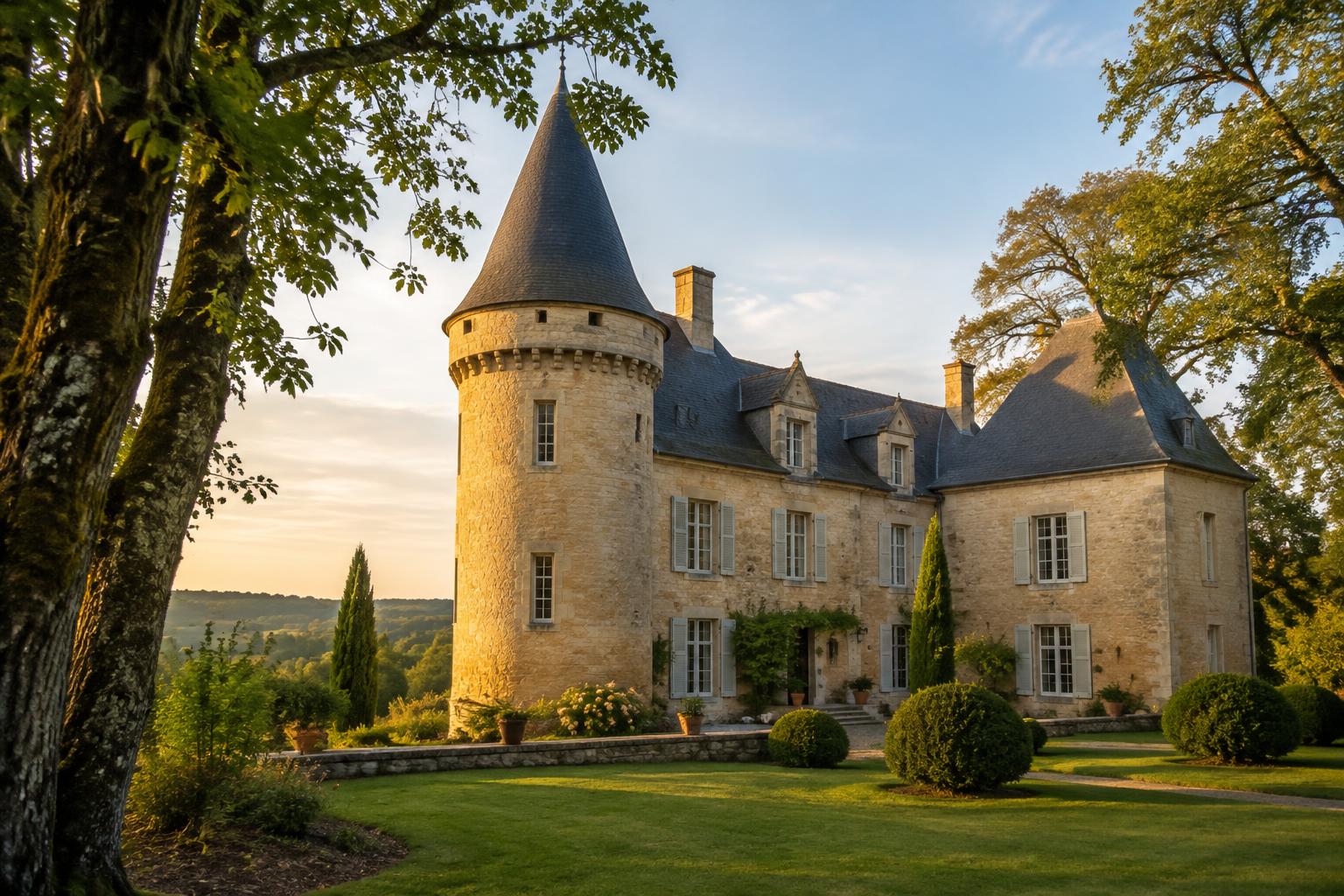
A building of natural stone with towers, battlements and a park all around. Anyone searching for a chateau for sale in France, a manoir or a domaine, quickly feels the pull: the scale, the materials, the sense that something special stands here.
But buying a chateau in France is not a decision you make on feeling alone. On a protected building, the authorities have a say in what you may renovate. Maintenance of roofs, facades, gardens and water features calls for an annual budget that an ordinary house does not have. And the land around it can carry pre-emption rights, forestry rules or hunting rights.
This article describes what you can check before making an offer on a chateau for sale Dordogne or elsewhere, alongside the official French rules and deadlines. The goal is not to make it complicated — it is to know where you stand before you commit.
Have you spotted a château, manoir or domaine? Email us the listing link and your main question. We will look with you at whether the building is protected and what that means for your plans.
Email us about this estate1. First this: is the building protected?
With a historic property there are two entirely different situations, and advertisements often blur the two together.
Protected monument (monument historique). A building can be listed (inscrit) or classified (classé). This is not a marketing label but a legal protection measure of public interest: a public-law restriction on the property, decided on the advice of the competent commission by the regional prefect (listing) or by the Minister of Culture (classification). [1]
Fondation du Patrimoine label. This label is, by contrast, aimed at heritage that is not protected as a monument historique. It is awarded following favourable advice from the departmental unit for architecture and heritage (UDAP), aimed at owners carrying out a restoration programme. [2] It is a voluntary, tax-related tool — not a legal building restriction beyond the ordinary planning rules.
So always ask: is this property protected as a monument historique, and if so, is it listed or classified? The answer determines who must give permission before you change anything.
2. What protection concretely means for your plans
For a listed building, any alteration must be notified four months in advance to the regional prefect. If the works require a building or demolition permit, that permit cannot be issued without the agreement of that same prefect. [3]
For a classified building, authorisation from the Minister of Culture is required for works on the monument itself. A statutory processing period applies to that application; if the minister does not respond within the set period, this counts as approval. [4]
In the surroundings (abords) of a protected building, approval from the Architecte des Bâtiments de France (ABF) is required for works affecting the appearance of a building or outdoor space. If the prefect has set a périmètre délimité des abords, that approval requirement applies within that specific area defined for the monument. If no delimited perimeter exists, the approval requirement applies to buildings within 500 metres that are also visible from, or together with, the monument — so the 500 metres alone is not automatically decisive. [5] Ask the mairie or the UDAP for the exact situation for the property concerned.
Three consequences you need to know before making an offer:
- A renovation is no longer a private matter. You apply for permission, and you do not always get it.
- The timeline is longer. A prior notification, a processing period for classification and an ABF opinion for the surroundings: a renovation plan on or near a protected property follows a different timeline than a normal house.
- The obligation stays with the property. Protection is a restriction on the building, not on the previous owner. What applies now will apply to you later.
What the seller must disclose. When selling a protected property, the seller must inform the buyer of the existence of the classification or listing. [6] In addition, any transfer of ownership must be notified within fifteen days to the competent department, with the name and address of the new owner. [7]
A claim often heard. It is sometimes said that the State can always pre-empt a château. For an ordinary private sale between individuals, such a general pre-emption right does not appear in the sources consulted. What does exist: at a public sale of cultural property the State can pre-empt, and disposal of public property requires prior advice. [8] Have the notary confirm this point for your file — do not take it from an advertisement.
3. What upkeep really demands
There is no legally fixed maintenance budget for an estate. The official sources contain no standard for roofs, facades, gardens or water features; what does apply is the principle that the owner remains responsible for preserving a protected property. [3] In practice this means: you must map it out yourself, with quotes, and ask the running-cost questions yourself of the seller and of tradespeople — none of the figures below is a budget, they are questions to ask.
Map this out for each building and each outdoor space:
- Roof and gutters. Surface area, type of covering — many châteaux in these regions have slate or lauzes (heavy natural stone roof slabs) — age of the last works, load-bearing capacity of the roof structure for that weight, invoices and warranties.
- Facades and joints. For natural stone: type of pointing, previous restorations, and whether repairs were carried out with the original materials and techniques.
- Woodwork and windows. Shutters, window frames, staircases, floors — and what has already been replaced.
- Services. Heating, electricity, gas, ventilation, water, pool installation — and the real cost of heating a large volume.
- Park and outdoor space. Extent and condition of the park, trees, avenues, hedges, terraces, walls, fences and water features; who maintains them now and how often.
- Outbuildings. Barns, stables, dovecotes, wash-houses, orangeries — and whether they have their own use and their own upkeep questions.
For each of these items, ask specifically: when was this last checked or replaced, by whom, with which invoice, and which items have never been thoroughly inspected? A verbal explanation from the seller is not a document.
Have structural doubts investigated separately. The mandatory diagnostic pack (DDT) is a statutory minimum list, not a structural survey. For a large or old property, an independent structural survey is a separate step; ask for quotes and guarantees.
Energy diagnosis. For most homes a valid DPE (energy performance diagnosis) is required at sale. Classified or listed monuments historiques are exempt from this DPE obligation. [9] So for a property without protected status, do ask for a valid DPE, and for a protected property ask for clarity that the exemption genuinely applies.
Insurance. Outside a co-ownership, fire insurance is not legally compulsory for a home. You do, however, remain liable to third parties for damage originating from your property. [10] For an estate with many buildings, a park, visitors or rental activity, ask for a targeted quote covering these risks, and do not leave that price until the last minute — for large surface areas and special materials the premium can differ substantially from an ordinary house.
A swimming pool. An uncovered, buried swimming pool must be fitted with an effective safety device: a barrier, an alarm, a safety cover or a shelter. [11] At a viewing, ask which system is installed and whether it is maintained.
Unsure about protection or upkeep? Email us the property you have in mind and what you plan to do with it. We will look at which permissions are needed and which questions you can put to the seller and to tradespeople.
Email us about protection and upkeep4. Tax support: what really exists and what you should not assume
For protected properties, tax schemes do exist in France, but they are subject to conditions. The main one is set out in article 156 of the French tax code (code général des impôts). [12]
Broadly, it works as follows: depending on whether the property generates income (for example through paid visits) and whether the owner lives in it, costs and any resulting losses of a protected property can be deducted in whole or in part from income, with a specific carry-forward period for any loss. [13] The Fondation du Patrimoine label falls under the same scheme, provided it was awarded following favourable UDAP advice. [14]
Three warnings that matter:
- These schemes are not automatic. They depend on opening to the public, on occupation, on the nature of the works and on correct administrative handling.
- A holding period applies. To benefit from the special regime for direct deduction against general income, the owner must generally commit to keeping the property for at least fifteen years and to holding it directly, subject to specific exceptions for certain company structures. [15]
- Exact amounts are subject to change. Specific fixed amounts from older tax commentary have deliberately not been included in this version because up-to-date 2026 confirmation was not available at the last check. Ask the notary or your tax adviser for the exact, currently applicable amounts and conditions before relying on any figures.
Reduced purchase costs also exist, but not for every property. Reduced or exempt registration-duty rates are tied to specific situations, for example rural property let to a young farmer receiving installation support. [16] For a private estate without farming activity, this will often not apply. Have the notary assess this point for your file.
Transfer tax (DMTO). In Dordogne, Lot and Corrèze the departmental rate for most existing homes is 5.00%, within the total purchase costs the notary calculates for you in advance. [17] This rate can vary by department and can change; have the notary make the current calculation for your specific file.
5. Land, forest and hunting: what comes with the grounds
Pre-emption rights. For an estate with rural land, SAFER may intervene; the notary must notify a sale of rural property in advance. [18] In addition, the notary usually sends a declaration of intent to sell (DIA) to the municipality, which has a period to decide against purchasing. [19] Ask about the outcome of both procedures.
Forest. If you own more than 20 hectares of forest on a single plot, or on plots that together reach that threshold, an approved simple management plan (Plan Simple de Gestion) is mandatory; this threshold was lowered from 25 to 20 hectares by the law of 10 July 2023. Between 10 and 20 hectares, a PSG is voluntary. Owners newly brought under this obligation by the lower threshold had to submit their PSG for approval by 12 July 2026 at the latest — that date has now passed. [20] So for an estate with forest, ask: how many hectares, and is there an approved management plan, and if not, why not?
Hunting and fencing. Since the law of 2 February 2023 on enclosed hunting grounds, additional rules apply to fenced hunting plots, with consequences for the management plan and for the free passage of game in certain natural areas. [21] For an estate with hunting rights or high fencing, ask about the agreements and plans in force, and have the competent department confirm this for the specific plot.
Boundaries. A boundary survey (bornage) is not legally required in every case, and can only take place between two different owners. [22] For an estate with scattered plots in particular, it is worth asking whether a boundary survey exists and, if not, when one could take place.
6. Gîtes, events and rentals: rules first, then the plan
A château with gîtes, a wedding hall or an event space calls for a separate check, independent of how appealing the plan itself is.
- Zoning. Ask the mairie about the applicable local land-use plan (PLU) rules for the plot and whether commercial activity such as rentals, catering or events fits within it.
- ERP status. As soon as a space receives the public — for example for a wedding or a paid visit — that space can count as an établissement recevant du public (ERP). An ERP is classified by category based on visitor numbers and must meet fire-safety and accessibility requirements, with an authorisation procedure via the mairie and the competent safety commission. [23]
- Tourist rental. A furnished tourist rental (meublé de tourisme) must be declared to the tax authorities and, in many municipalities, also to the mairie; the same guest may not stay longer than 90 consecutive days per calendar year in a main residence, and additional time limits apply to homes with a low energy rating. [24]
Have each of these points confirmed for the specific building and activity by the mairie and, where needed, a lawyer or notary, before developing a rental or renovation plan around gîtes or events any further.
7. The purchase itself: what the notary checks on an estate
The notary checks the title deed and the seller, the mortgage status, the land-use rules, the cadastral situation, the municipality's pre-emption right and, for rural property, that of SAFER. [25] For an estate, additional questions arise that do not apply to an ordinary house:
- Are all the plots included? Compare the listing, the preliminary contract (compromis) and the cadastral extracts. On estates, plots can exist that do not appear in the photos.
- Are there any easements? Rights of way, pipelines, third-party rights. Some are not in the land registry and only appear from older title deeds. [26]
- Is the entire property for sale? In the case of inheritance or joint ownership, every co-owner must agree to the sale.
- What is the state of the paperwork? Invoices, guarantees, permits and earlier restoration files — a protected property should come with documentation of previous works.
- What does the compromis state? Price, movable items included, deadlines, conditions and who pays the agency fees.
Second home or main residence? A second home is subject to the taxe d'habitation for secondary residences; the assessment follows from the situation on 1 January. In municipalities with a tight housing market, the local authority can set a surcharge on this. [27]
Checklist: what you want to know before an offer on a château or domaine
Note down for each point the answer, the supporting document, and what is still outstanding.
- Status: is the property protected as a monument historique — listed or classified — or does it only carry a label?
- Surroundings: does the property lie within a defined périmètre délimité des abords of another monument, or does the 500-metre-and-visibility rule apply, and what does that mean for my plans?
- Deadlines: do I know how long a notification or approval takes for the work I have in mind?
- Upkeep: do I have quotes and documentation for the roof (including lauzes or slate), facade, park, outbuildings and services, with clarity on VAT?
- Structural: has an independent structural survey been carried out, separate from the statutory diagnostic pack?
- Energy: is there a valid DPE, or does the exemption apply because the property is classified or listed?
- Annual charges: have I seen the taxe foncière assessment and, for a second home, the secondary taxe d'habitation assessment?
- Tax: has my intended use (living in it, visits, renting) been assessed by a tax adviser or the notary against the article 156 schemes, including the holding period?
- Purchase costs: do I have an up-to-date notary estimate with the current departmental DMTO rate?
- Land: are the plots, boundaries, access and rights clear; is there a boundary survey?
- Forest: how many hectares, and is there an approved simple management plan (PSG)?
- Hunting and fencing: which rights and plans apply to game and fencing?
- Pre-emption: what are the deadlines for the SAFER notification and the municipal declaration?
- Gîtes and events: is the zoning suitable, and is it clear whether a space must be classified as an ERP?
- Insurance: is there a quote for appropriate cover for these buildings and this use?
- Contract: have my conditions, financing and deadlines been explained before signing?
Spotted a château or domaine?
You do not have to work out what is and is not allowed on your own. Send us the property you have found and tell us what you plan to do with it. Bureau Moulin requests the documents from the agency, looks into the protection status, the plots and the rights, and helps you make a careful selection. We then plan the viewings together and, if you wish to go further, support you with the negotiations and the process through to the notary.
Our property search focuses on Dordogne, Lot and Corrèze, within a maximum of an hour and a half's drive of Brive. If you would like to settle in France after the purchase, Natascha can also support you with the administrative matters.
Shall we discuss your plans? Email Ruud and Natascha your listing link or search criteria and your main questions. You can also get in touch even if you have not yet chosen a property.
Email Ruud and NataschaSources
Checked on 15 October 2026. General information for a private purchase of a historic property, estate or château in mainland France, not personal legal, tax or structural advice. Whether a property is protected and which schemes apply depends on the file; have this confirmed by a notary, tax adviser or the competent department. Rates, amounts and deadlines may change.
- Ministry of Culture — classification or listing of a monument historique
- Ministry of Culture — the Fondation du Patrimoine and its label
- Ministry of Culture — carrying out works on a listed building
- Service Public — works on a classified property and the implicit-decision deadline
- Ministry of Culture — the surroundings (abords) of a monument historique: perimeter and 500 metres
- Code du patrimoine — duty to inform on transfer of a protected property
- DRAC Nouvelle-Aquitaine — guide to monuments historiques taxation, 15-day notification of transfer
- Code du patrimoine — pre-emption right at public sales of cultural property
- Service Public — DPE: exemption for classified or listed monuments
- Service Public — insurance and liability of an owner
- Service Public — mandatory safety device for private swimming pools
- Légifrance — article 156 of the Code général des impôts
- DRAC Nouvelle-Aquitaine — guide to monuments historiques taxation: losses and costs
- Ministry of Culture — tax schemes for protected buildings and the label
- DRAC Nouvelle-Aquitaine — guide to monuments historiques taxation: 15-year holding period
- Tax authority — BOFiP, reduced registration duties for rural property
- Government table — droits d'enregistrement by department, 1 June 2026
- SAFER — explanation of the pre-emption right
- Notarial practice — what the notary checks at a sale (municipal declaration)
- CNPF — lowered threshold of 20 hectares and the 12 July 2026 deadline for a PSG
- Ministry — enclosed hunting grounds and the wildlife management plan obligation
- Notaires de France — boundary survey (bornage)
- Service Public — what is an établissement recevant du public (ERP)
- Service Public — second home as a tourist rental (meublé de tourisme)
- Service Public — sale deed of an existing home and what the notary checks
- Notaires de France — easements and rights of way
- Service Public — taxe d'habitation on secondary residences